


- Eye protection: Use appropriate protective eyewear to protect your eyes from chemical substances.
- Skin protection: Use body protection and protective gloves. Prevent physical contact of chemicals released from a damaged battery with your skin.
- Prevent inhalation: During overcharging, short circuits or mechanical damage, toxic gas hydrogen fluoride (HF) can form and be released from a Li cell. If LFP cells are used in a closed space in the presence of people, appropriate protection for the cells and these people in case of an emergency and HF release must be ensured.
- If white gas is released due to overcharging, short circuit or mechanical damage of the cell/battery, it is necessary to protect all present persons and prevent them from inhaling this gas.
- If possible, move the cell outside. If not possible, evacuate all people from the interior space where the gas could spread.
- This gas may contain highly toxic hydrogen fluoride (HF), which inhaled can cause death or temporary or permanent health problems.
- charged to 30 - 50 % of nominal capacity
- in a position with the vent valve and terminals facing upward.
- in packaging conforming to ADR Category 9 and labeled as "UN 3480".
- out of reach of children, away from foods, medicines and easily flammable materials.
- water vapour, mist and splashing water.
- condensation, freezing and temperatures above 40 °C,
- vibrations, shocks, punctures and pressure effects.
- direct sunlight and pulsating heat
- aggressive gases and vapour
- improper placement
- 4A/1mm2 - continuous
- 6A/1mm2 - short-term up to 1h
- 8A/1mm2 - peak max. 1 min.
- Method of collection or recycling of batteries:
The collection and recycling location is the seller's address at the time the contract is concluded. - Possible negative effects of materials used in batteries and accumulators on the environment and human health:
Batteries and accumulators contain chemical substances that negatively affect the environment and human health. Overcharging, short circuits or mechanical damage can cause the formation and release of toxic hydrogen fluoride (HF) from a battery cell. If LFP cells are used in an enclosed space in the presence of people, ensure appropriate protection for these people in case of an accident and HF release. - Graphic symbol for recycling and collection and the purpose of the labels:
This is the graphical symbol for separate waste collection:
Lithium cells and batteries are sources of electrical voltage and current that can be used repeatedly. They can be used as a replacement for other types of accumulators if the proper overall voltage and maximum current are maintained. However, they have different charging and discharging characteristics than lead-acid batteries (SLA, VRLA) as well as nickel- and cadmium-based batteries (NiCd, NiMH).
POTENTIAL RISKS
Risk of short circuit and fire
Charged and uncharged cells contain a large amount of electrical energy, which can ignite the connecting wire and cause an electrical spark or arc in the event of a short circuit. Lithium cells contain an organic solvent that can ignite, for example from heated contacts, from sparks, etc. The plastic housing of the cell can also ignite, as can other flammable substances.
Hazards of injury from direct current
With a larger number of cells and batteries connected in series, the risk of injury from direct current increases. Under no circumstances should you touch live electrical conductors or other live components. In some cases, even the so-called safe current, which is below 60 V, can cause fatal injuries from electric current.
Risks associated with chemical substances
Lithium cells and batteries do not contain any caustics or acids. They do, however, contain chemical substances that affect the human body and can cause chemical reactions, e.g., heavy metals and organic solvents. When handling cells and batteries, you must follow the following principles:
INFORMATION FOR THE END CONSUMER
Batteries may be used only by a person who has been properly trained and informed about the use of lithium cells and batteries. Information and training are provided by the final seller. In the case of remote selling, instructions are provided in the user manual included with the delivery. Further information on using the cells is provided on the seller's website.
TRANSPORT, USE AND STORAGE RULES FOR LITHIUM CELLS
Lithium cells are transported as dangerous goods under ADR regulations and in most cases are not eligible for air transport. Do not transport them in passenger cars, do not send them in standard packages sent by ordinary mail or courier service. You could cause substantial property damage and injury to people.
Cells are stored and transported as follows:

Cells must be protected from adverse external conditions, especially:
Batteries may be stored in original non-flammable fiberboard packaging in a maximum of three stacks. When stored in other packaging or in stacks of more than 3, deformation of the cells can occur and there is a danger of fire or leakage of chemical substances.
Terminals and the plastic wrap must not be welded, soldered, opened, repaired or mechanically modified. Otherwise there is a danger of contact with hazardous chemical substances.
Do not close cells in packaging or covers that would cover or block the safety vents on the top of the cells. Any modifications should first be discussed with the seller and obtain their written opinion on the matter.
Do not mix cells from different production series, even if they are the same type and capacity, and do not install such cells together. For each battery always use cells from the same production series and the same delivery batch.
Operate batteries under supervision or using continuous monitoring via a protective and control system (BMS), see below. Protect against overcharging and undercharging.
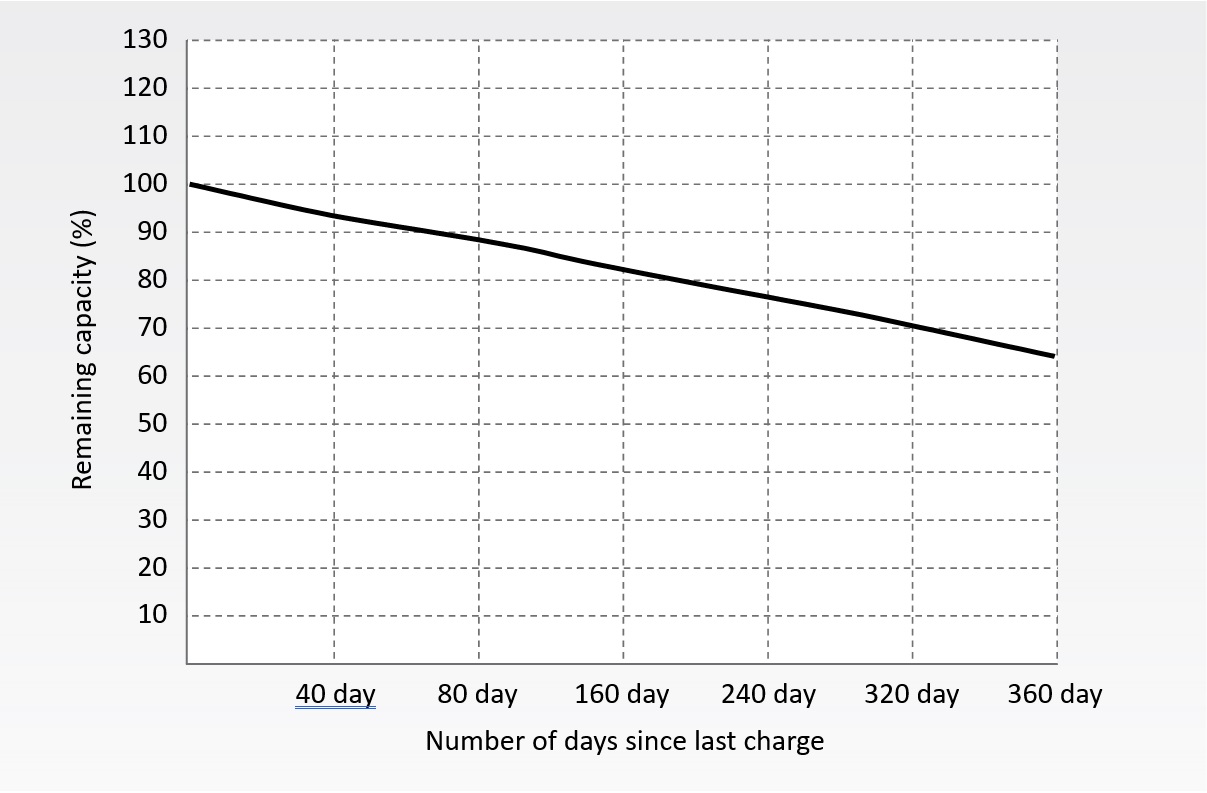
SELF-DISCHARGE
Most LiFePO4 batteries and cells have a very slow self-discharge rate. Therefore they can be stored long-term after initial charging. The typical discharge curve is given in the specification of each cell.
INITIAL CHARGING
New LFP/LFYP cells are delivered from the factory partially charged. Before first use, the batteries must be charged to full capacity. This initial charging should be performed at a current of up to 0.5C with voltage according to the battery or cell specifications (usually 3.8 V for LiFePO4). The battery capacity increases gradually over the first few cycles. In the first few cycles, the cell must not be discharged or charged to full capacity at a current greater than 1C (twice the capacity). The cells can be used to their full specification after up to 5 cycles.
STANDARD CHARGING OF LiFePO4 CELLS / BATTERIES
Carefully check the maximum charging voltage according to the specification of the cell or battery. If this charging level is exceeded (usually 3.8 to 4.2 V per cell), the cell/battery will be irreversibly damaged and the warranty will be void.
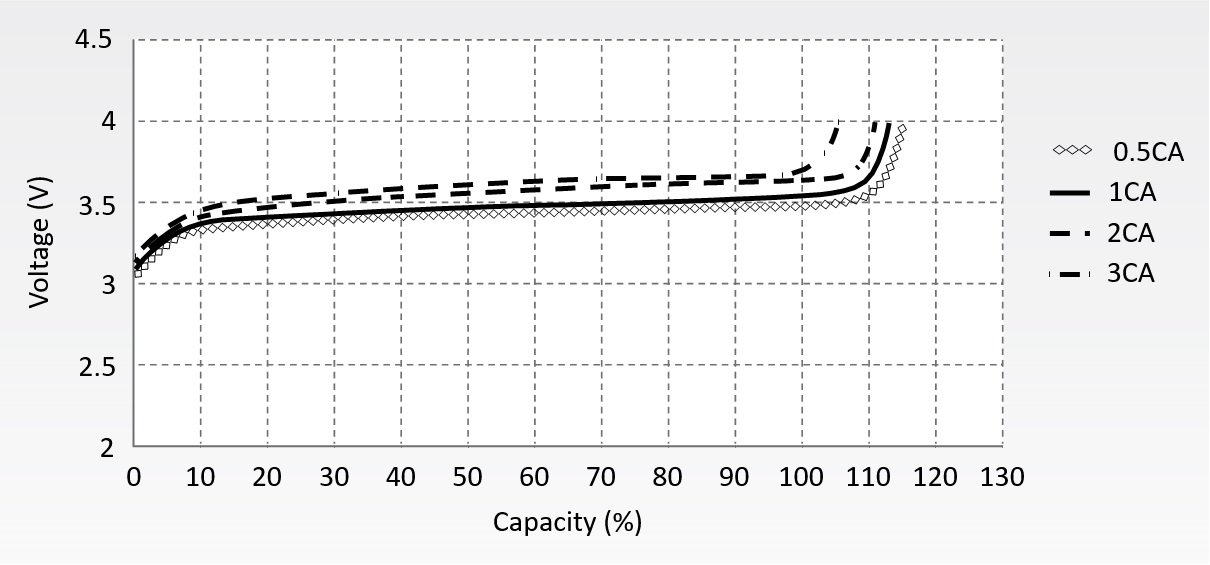
Cells/batteries have no memory effect, and therefore they can be charged and discharged at any time. Repeated short charging/discharging cycles do not affect the battery life. The maximum charging current for individual cells and batteries is given in the specifications. Cells must not be kept in a floating/absorbing mode above 3.50 V. After reaching the maximum charging voltage (usually 3.60 V) charging must be interrupted and not continued until the cell or battery has discharged by at least 10% of its nominal capacity. This voltage applies only to standard LiFePO4 cells at standard temperatures, i.e., 15 °C - 35 °C. Example VA characteristics at charging with different currents:
STANDARD DISCHARGING OF LiFePO4 CELLS /
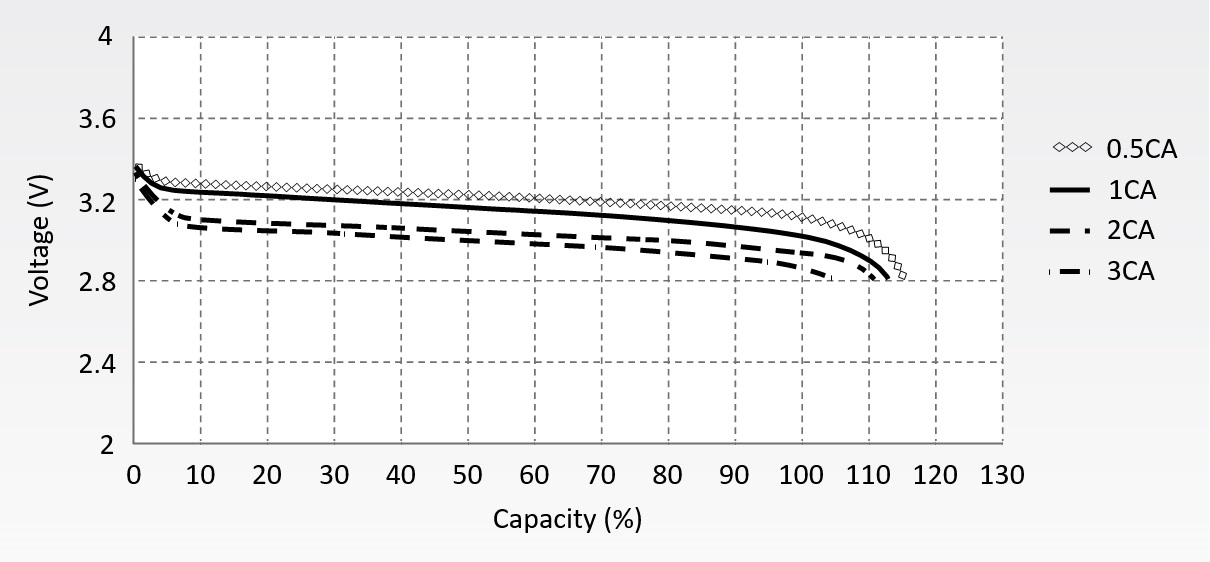
Carefully check the lowest discharge voltage according to the specifications of the cell or battery. If the voltage drops below the minimum (usually 2.50 V for LiFePO4 at 25 °C), irreversible damage to the cells occurs and the warranty is void. Example discharge characteristics V-A at various currents:
LiFePO4 CELL/BATTERY CHARGING AT NON-STANDARD TEMPERATURES
Electrical properties of LiFePO4 cells change at temperatures below 5 °C, particularly regarding terminal voltage, internal resistance and capacity. Please note the technical specifications for each model. In general, expect a reduction in actual cell voltage and limit values for charging and discharging. Example:

For standard LiFePO4-based cells, the temperatures shown in this graph generally apply. Example: At -25 °C, the BMS protection settings should be adjusted so that discharging stops at 2.0 V and the cell is fully charged only up to 2.8 V. If -25 °C is reached, adjust the BMS protection settings so that discharging stops at 2.0 V. The maximum capacity (measured in Ah) that the cell can absorb and release will be approximately 92% of the nominal capacity.
CHECKING THE STATE OF HEALTH OF CELLS/BATTERIES
Checking the state of cells and batteries and balancing the cells/batteries to the same voltage is performed after charging cells/batteries in series by physical on-site inspection and further by connecting a charger/protection device to each individual cell/battery. The state of health of cells/batteries and balancing to the same voltage must be performed at least at the following intervals:
1) during first charging2) after the first cycle
3) after the first 5 cycles or 7 days, whichever occurs first.
4) after the first 20 cycles or 30 days, whichever occurs first.
5) periodically every 200 cycles or 12 months, whichever comes first.
The buyer is obliged to keep written records of the inspections and to archive and present these records when making a warranty claim.
CONNECTING CELLS AS A BATTERY
Cells can be connected in parallel (increases capacity), in series (increases voltage) or series-parallel (increases voltage and capacity). Much information is described on our technical blog; follow the link below to access the information guide on linking cells. Use only the original terminal connectors supplied with the cells by GWL.
Connectors from other manufacturers or various replacements (rigid straps) may, due to their lower flexibility, damage the cells.
Do not use screws and nuts other than those supplied in stainless steel. Fasteners made of other materials (galvanized, brass, copper, etc.) may damage the terminals or over time you may not be able to loosen and unscrew them.
Immediately before installing and tightening the connectors on the terminals, carefully clean the contact surfaces with sandpaper of approximately 200 grit. Oxidation of the terminals, or their darkening from the rubber cap, is a natural phenomenon that is not related to the production date, does not change the properties of the cell and does not affect its longevity.
Screws should be tightened carefully and firmly. For ALUMINUM cells with small terminals (ELERIX brand) the torque is up to 4 N/m. For WINSTON cells with large terminals the maximum torque is: 9 N/m for 40 and 60 Ah cells, 20 N/m for 90-200 Ah cells and 60 N/m for 300 Ah and larger cells. Regularly check proper tightening.
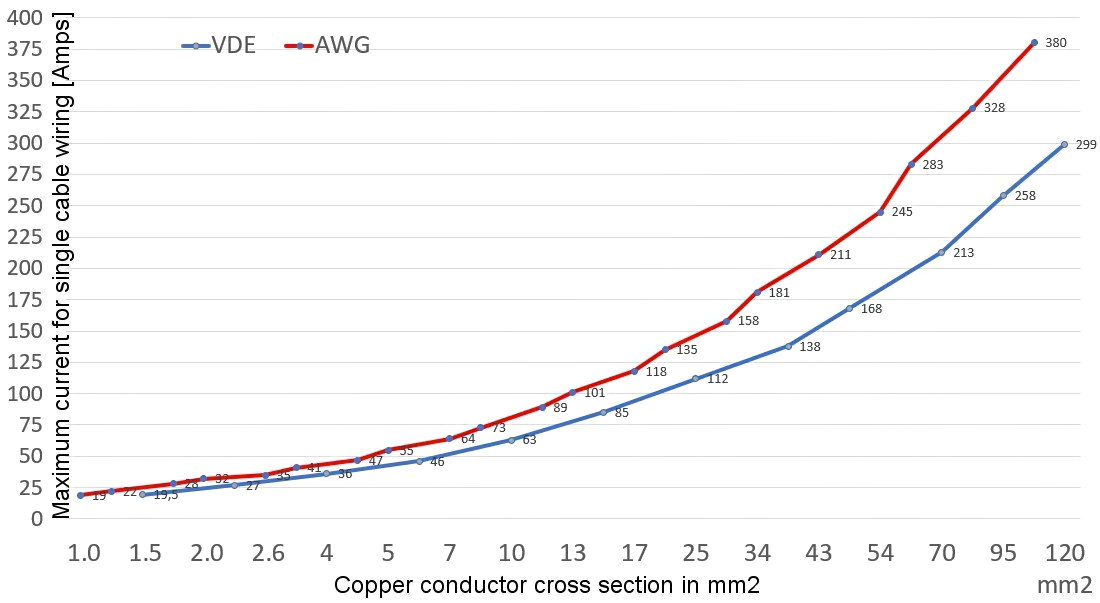
How to calculate the maximum current for a given terminal connector?
Important parameters for calculation are the cross-section of the terminal block multiplied by the width of the terminal block.
See recommended current loading per 1 mm2
Terminal block current rating is not linear! The current rating decreases with increasing cross-section of the terminal block.
USE OF THE BMS SYSTEM
If the purchaser connects lithium cells into a battery string, they are required to install an electronic system for monitoring and recording the individual states (voltage, temperatures, etc.) of each cell, also called a "BMS".
To ensure proper function and for warranty claims, the cells and batteries must be continuously monitored. If there is a fault or incorrect functioning of any cell, this cell/battery must be removed from service. In order to claim warranty, it must be properly proven (e.g., by records from the BMS) that the cell or accumulators were not discharged below the minimum voltage or that they have not been overcharged above the maximum voltage using BMS records or other monitoring devices.
 WARNING:
Most BMS systems have their own idle consumption, which can discharge a cell below the minimum allowable voltage. If you use such a system (e.g., BMS123), you must regularly recharge the cells.
 WARNING:
Do not rely on a single method of protection against overcharging or overdischarging. Always install two independent forms of protection.
EXPECTED LIFE EXPECTANCY OF LiFePO4 CELLS/BATTERIES
Number of months from purchase date or number of charge cycles, whichever occurs first | Estimated actual cell capacity relative to nominal capacity for discharge and charging at up to 0.5 C, within 10-90% of nominal capacity. |
|---|---|
up to 6 months / < 500 cycles | >95 % |
6 - 60 months / < 2000 cycles | >80 % |
60 - 120 months / < 3000 cycles | >60 % |
This table is for illustration only. The specific remaining capacity of the cells depends on many factors, such as ambient temperature, operating currents, used BMS, etc.
RECYCLING OF BATTERIES AND CELLS - INFORMATION REQUIRED BY LAW REGARDING THE FOLLOWING POINTS:
Please do not throw batteries into household waste or into fires, do not burn them or throw them in landfills. Return batteries to a recycling centre or battery collection point.